
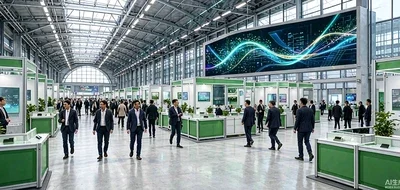
China's Exhibition Industry in the Opening Year of the 15th Five-Year Plan: From Scale Expansion to Value Deepening, with Digitalization and Green Practices as Twin Engines
As 2026 marks the opening year of China's 15th Five-Year Plan, the country's exhibition industry stands at a critical juncture on its path from "large" to "strong." The industry is moving away from pure scale expansion and accelerating toward deeper digitalization, greener practices and internationalization.
2026 is the opening year of China's 15th Five-Year Plan, and the direction of the country's exhibition industry is becoming clear: moving away from extensive scale expansion toward value deepening built on quality, efficiency and sustainability.
This shift has become a broad consensus, as seen in the industry's busy calendar this year. In late August, the 2026 Zhengzhou International Exhibition Culture Festival and Exhibition Investment Cooperation Conference brought together representatives from more than 40 national-level industry associations and over 200 exhibition organizations. Experts reached a strong consensus at the event: the industry should proactively make a "structural subtraction," phasing out low-barrier, overheated tracks and concentrating resources on polishing flagship exhibitions. One exhibitor executive put it bluntly: "In a period of stock competition, chasing the number of shows dilutes talent, capital and industry resources, and ultimately makes every show mediocre."
The scale data confirms the stage the industry has reached. In 2025, China hosted approximately 4,095 trade exhibitions with a total exhibition area of about 159 million square meters, fully surpassing pre-pandemic levels. In 2026, the industry has entered a phase of steady growth, with consolidation accelerating among leading players and "small but beautiful" professional shows in vertical segments becoming mainstream. Meanwhile, the share of exhibitions held in the four core cities of Beijing, Shanghai, Guangzhou and Shenzhen is gradually declining, while new first-tier exhibition cities such as Chengdu, Chongqing, Xi'an and Hangzhou are rising rapidly, driving significant growth in cross-city booth construction demand.
Digitalization and green practices are widely regarded as the two engines of the next stage. On the digital side, technologies such as AI-powered guided tours, digital-twin online showrooms, immersive lighting and glasses-free 3D are moving from "nice to have" to "standard equipment," and the use of hybrid (online plus offline) formats at benchmark overseas shows has approached 60 percent. On the green side, the Ministry of Commerce is guiding the industry to adopt zero-carbon booths and modular, reusable construction. Recyclable profiles and eco-friendly panels are gradually becoming mandatory requirements in tendering, and aluminum modular booths can achieve a disassembly-reuse rate of over 80 percent.
In terms of internationalization, deepening cooperation under RCEP and the Belt and Road Initiative continues to drive demand for outbound participation in Southeast Asia, the Middle East and Europe, with demand for overseas custom booth construction rising in tandem across machinery and electrical equipment, home furnishings and consumer goods. Many exhibition service providers say that helping companies "sail out and connect globally" is becoming a new growth point for exhibition services.
For exhibitors, this transformation raises new questions: how to choose more focused professional shows, how to control long-term costs with greener construction solutions, and how to extend a show's marketing cycle through digital tools. These are precisely the questions that exhibition service companies must answer together with their clients.